
Uncategorized
Under-Eye Fillers: Results, Eye Bags, Before and After, and What It Costs

Dermal filler is one of the quickest ways to soften a hollow, shadowed look under the eyes. It is also one of the easiest treatments to get wrong. This guide covers who it suits, what it can and cannot do for eye bags, how to read before-and-after photos, and what to budget.
What dermal fillers under the eyes actually do
Under-eye filler, usually called tear trough filler, is a gel injected into the groove that runs from the inner corner of the eye diagonally across the upper cheek. Most injectors use hyaluronic acid (HA), a substance the body already makes. HA fillers hold water and add volume, and they can be dissolved with an enzyme if the result is not right.
The aim is to replace volume that has been lost. As we age, fat and bone support in the midface thin out, and the groove under the eye becomes deeper. Light then drops into the hollow and casts a shadow that looks like dark circles. Filler lifts the floor of that groove so the shadow shrinks.
Dermal fillers for under-eye bags
This is the most misunderstood part of the treatment. Filler does not remove eye bags. A true bag is a bulge, usually caused by fat that has moved forward or by swelling. Filler can only add volume, so it works on a bag indirectly, by filling the hollow beside it so the bulge no longer casts a shadow or stands out against a deep groove.
Often a good fit
- Mild to moderate hollowing or shadowing
- Early, small bags that sit just above a visible groove
- Skin that is fairly thick and firm
- Dark color that comes from shadow, not pigment
Often a poor fit
- Large, protruding bags or loose, crepey skin
- Puffiness that comes and goes with sleep, salt or allergies
- Brown or blue pigmentation in the skin itself
- Festoons or malar bags (swelling lower on the cheek)
Clinicians quoted by consumer health outlets are consistent on this point. Dermatologists told TODAY that very loose skin can mean you do more harm than good with filler, and that surgery is the better route. Where puffiness is caused by fluid retention, filler may make it look worse.
A simple self-check. Gently pull the skin under your eye downward with a fingertip. If the hollow stays visible, or you can see a bulge sitting above it, filler alone is unlikely to give you the result you want. Ask about lower eyelid surgery (blepharoplasty), fat repositioning or skin treatments instead.
Under-eye filler before and after: what to expect
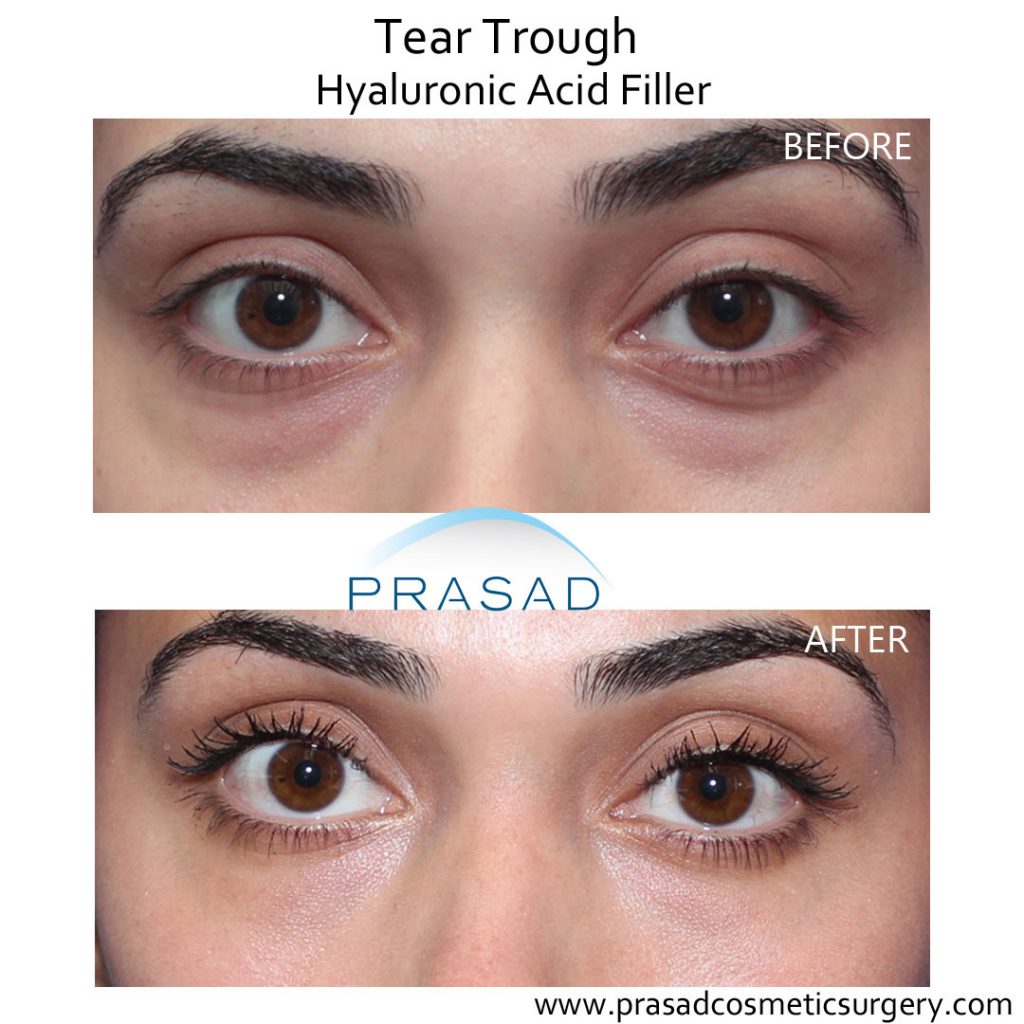
A good result looks like less shadow, not more volume. Eyes look rested, and nobody should be able to point to where the filler is. Immediate results are visible, but swelling can make the area look fuller or slightly uneven for the first few days.
How to judge before-and-after photos
- Same lighting and angle. Lighting alone can make dark circles look better or worse.
- No heavy retouching. Look for natural skin texture in both photos.
- Photos at two weeks or later. Day-of photos hide swelling.
- Patients like you. Ask for examples with your age, skin type and degree of hollowing.
- Consent. Reputable clinics show their own patients’ photos with permission, not stock images.
How much do dermal fillers under the eyes cost?
Under-eye filler is priced per syringe (1 ml). The range is wide, and published figures vary by source and city. In the United States, most clinics quote roughly $600 to $1,500 per syringe. All About Vision puts the average HA filler used under the eyes at about $715 per syringe, while a dermatologist interviewed by TODAY said her practice charges around $1,000. Some specialist surgical practices in New York City charge considerably more, with one listing $2,500 per syringe for Restylane. In the UK, clinics commonly quote about £350 to £550 per syringe.
Risks and side effects
Common effects are swelling, bruising, tenderness and small lumps that settle in the first two weeks. Less common problems can be serious.
- Lumps, puffiness or a bluish tint. Filler placed too shallow, or in the wrong amount, can show through thin skin. This is sometimes called the Tyndall effect. HA can usually be dissolved.
- Persistent swelling. Filler holds water, and this area drains slowly.
- Vascular occlusion. Filler blocking a blood vessel is rare but is an emergency because it can affect skin and, near the eye, vision. Severe pain, sudden color change in the skin, or any change in vision after treatment means you need urgent medical care. A trained injector will know the signs and keep dissolving enzyme on hand.
- Infection and allergic reaction. Uncommon.Avoid treatment if you have an active skin infection near the eye, are pregnant or breastfeeding, or have conditions such as thyroid eye disease. Tell your injector about all medicines and supplements, especially blood thinners.
How to choose an injector
- Choose a licensed doctor, dermatologist, plastic surgeon, oculoplastic specialist or experienced nurse working under medical supervision.
- Ask how many tear trough treatments they do each month, and what they do if something goes wrong.
- Expect an assessment of your whole midface. Good injectors often suggest cheek support first, because it can reduce how much filler goes under the eye.
- Be wary of very low prices, pressure to book on the spot, or an injector who promises to remove bags.
- Ask what product will be used and confirm it is HA, so it can be reversed.
If filler is not right for you
Depending on your anatomy, alternatives include PRP injections, laser or other skin resurfacing, topical treatments for pigmentation, fat grafting, and lower eyelid surgery for significant bags or excess skin. A consultation with a surgeon who offers both surgical and non-surgical options gives you the most honest comparison.
